
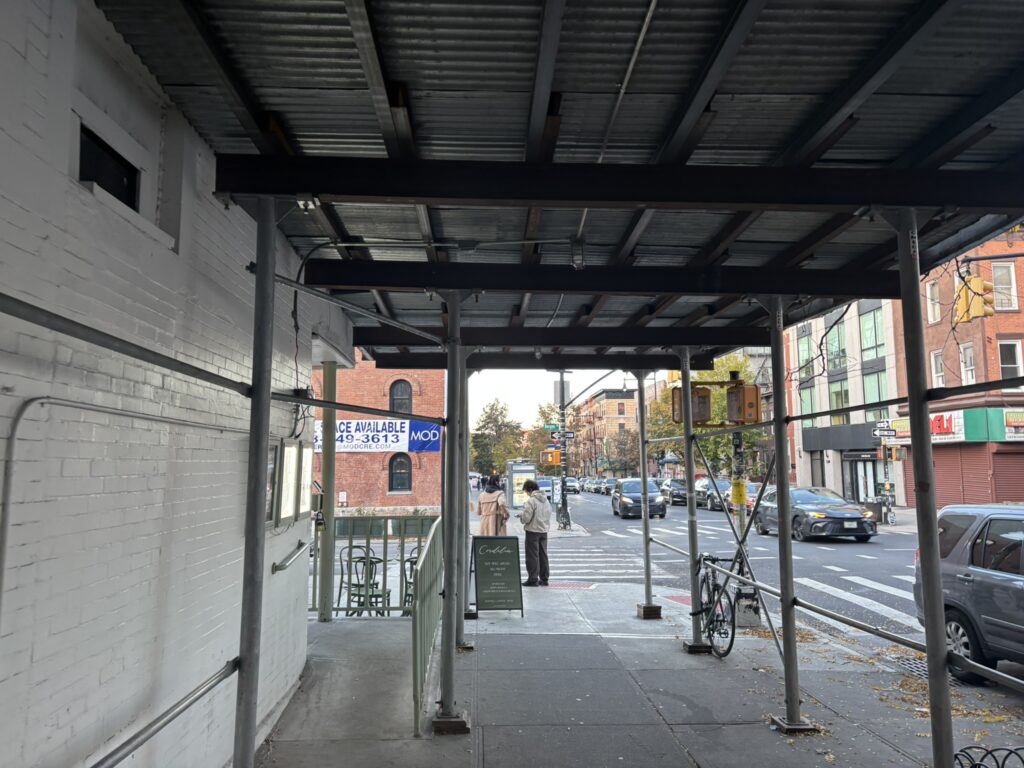
Since January, roughly 900 sidewalk sheds have gone up on New York buildings taller than six stories. As of November 3, close to 400 of them had passed five months and roughly 80 had passed eight. For a shed put up for facade inspection repairs, those are the dates when the City expects construction documents for the repair and then a complete permit application.
DOB expects to start issuing penalties under the new shed laws in early 2027. When it does, it will read the progress reports you file at each 90-day renewal. If your board or managing agent oversees a shed on a facade job, those reports are the record DOB will use to judge your building.
This article covers what the reports require, which rules apply to your shed, what the penalties are, and what to check before your next renewal.
What renewal now requires
Shed permits issued or renewed since February 2, 2026 last 90 days and no longer renew automatically. DOB’s rule implementing Local Laws 48 and 51 of 2025 (1 RCNY §102-07) took effect on August 13, and DOB NOW began asking for progress information at renewal on August 17.
Each renewal now needs a report of physical examination, sealed by a Professional Engineer or Registered Architect. The report covers:
- the work completed since the last renewal
- the work in progress
- an estimated completion date
- color photographs of every elevation and of each condition being repaired
The first report also sets a schedule for the repair, with the progress expected at each 90-day renewal through the end of the job.
Each renewal costs $130, plus $90 for the progress report.
Which rules apply to your shed
Three things decide which rules apply: the type of building, the work the shed protects and, for the milestone deadlines, when the first shed permit was issued.
If the building is a one- or two-family home, you file no progress report and owe no LL48 penalties. The 90-day permit term still applies.
If the shed protects permitted new building, enlargement or demolition work, it is exempt from the progress report and from the penalties.
Every other shed needs a progress report at each renewal. Starting with the second renewal of a permit issued after January 12, 2026, work must be in progress during every permit period. This applies no matter when the shed went up, so a shed standing since 2019 is covered.
If the shed was put up for facade work required by the Facade Inspection & Safety Program (FISP), which covers buildings taller than six stories, and its first permit was issued on or after January 12, 2026, the LL51 milestone deadlines also apply.
If the first shed permit was issued before January 12, 2026, the LL51 milestones do not apply. LL48 still does.
Two penalty clocks
The two laws penalize different failures on different schedules. You need to track both.
LL48 penalizes a shed with no work going on. From the second renewal, if no work on the underlying condition happens during a permit term, you owe a penalty for every linear foot of shed, for every month. The rate depends on the shed’s age:
| Shed age | Penalty per linear foot, per month |
|---|---|
| Under 3 years | $10 |
| 3 to 4 years | $100 |
| 4 years or more | $200, capped at $6,000 a month |
Penalties accrue every 30 days from the date of noncompliance. They stop when you file an acceptable progress report. DOB will not renew a permit until outstanding shed penalties are paid.
The cap applies only to the top tier, which changes when a long shed costs the most. An idle 100-foot shed costs $1,000 a month before its third anniversary, $10,000 a month between its third and fourth, and $6,000 a month after that. For any shed longer than 60 feet, the fourth year is the most expensive one to leave idle.
Sheds that old are not rare. By our count of DOB permit data, at least 557 sheds standing in late October have been on file for four years or more. Of those, 280 are on buildings taller than six stories. These numbers are a minimum, because the data only reaches back to filings in DOB NOW.
LL51 penalizes a repair that stalls. For sheds put up for FISP facade work, three deadlines run from the date the first shed permit was issued:
| Milestone | Deadline | One-time penalty | Extension fee |
|---|---|---|---|
| Complete construction documents filed | 5 months | $5,000 | $410 |
| Complete permit application filed | 8 months | $10,000 | $465 |
| Repair completed, Letter of Completion issued | 2 years | $20,000 | $1,425 |
Each LL51 penalty is charged once, for each missed milestone, and each milestone can be extended if your engineer or architect files a request at least 20 days before its deadline. LL48 has no extension process. Its penalties keep accruing for every month a shed sits idle, unless the progress report gives one of the few reasons the rule accepts for a pause, covered below.
Why the first report matters most
The rule asks for one schedule, in the first report, with the progress expected at each 90-day renewal through the end of the job. Each later report describes the work against that schedule. Before each examination, your engineer or architect must review the earlier reports and the weekly work log, and keep the records for six years.
The schedule can change. The rule lets the engineer or architect adjust it in any later report. Each adjustment is made in a sealed report on file with DOB, so the record shows every date that moved and the reason given for it. If the first report sets optimistic dates for drawings, permits and mobilization to get a renewal through, each later report will have to explain why the job is behind them.
The weekly log is where the reports get tested, and you are not the one who keeps it. The rule assigns it to the permit holder for the repair work or, where there is no permit holder, the contractor doing the work. It must be updated at least once a week and produced for DOB or your engineer on request. If a report says work was in progress and the log shows weeks with nobody on site, the building’s records contradict each other. That is the gap an LL48 penalty is designed to catch.
Your defense also depends on these documents. You can challenge a penalty within 30 days of service. DOB accepts proof of work during the period assessed, an accepted progress report, milestone filings made on time, or a granted extension. Each of these is a document. If your schedule, log and reports agree, your defense is already on file.
When work stops
The rule allows for stalled jobs, within limits. If no work happened during a permit period because of financial hardship, no access to a neighboring property or a shortage of materials, your engineer or architect must give the reason in the report and confirm that no hazard to the public or property exists.
That confirmation bears the same seal as the rest of the report. Even when work has stopped, the engineer or architect has to examine the whole site: the shed and its condition, the area around it and anything the shed does not protect, to confirm the protection in place will still hold up through the next 90 days.
Several common causes of delay are not on that list, including board approval cycles, financing draws, contractor availability and winter weather. The Real Estate Board of New York raised this in its comments on the proposed rule, arguing that owners face delays outside their control, such as weather, supply chain problems and extensive scopes of work, and that weekly log updates were too frequent. DOB responded that the filing requirements come from the law itself, and the final rule kept the weekly log.
Winter puts this to the test. Masonry, mortar and sealant work slows or stops in cold weather, and weather is not one of the listed reasons. If your schedule promised steady progress through the winter, your next reports will need to explain why work stopped.
If a milestone is going to slip, your engineer or architect can request an extension. Starting November 2, requests are filed in DOB NOW: Safety.
- The window for all three milestones opens 60 days before the five-month deadline. Each request must be filed at least 20 days before the deadline it extends, and each milestone needs its own request.
- The engineer or architect submits the request, and the owner logs in to attest to it.
- Supporting documents include repair drawings or a scope narrative, a contract and a project schedule through completion.
- DOB grants five- and eight-month extensions in increments of up to 180 days. The two-year milestone can get one longer extension.
- If DOB objects, you have 14 days to revise. A request still unacceptable after two notices is denied, and a new request means a new fee.
Approved and denied requests appear in DOB’s public portal, so a building’s extension history is public record too.
Buildings in historic districts also face Landmarks Preservation Commission review. We cover that in a separate article.
What happens in 2027
DOB is doing outreach now and expects to begin issuing penalties in early 2027. When it does, the progress reports filed since August 17, and the schedules and logs behind them, will already be on record. The City has said penalties can be paused when an owner shows meaningful progress. Under the rule, that means filing an acceptable progress report.
An unpaid penalty leads to more. DOB will not renew a shed permit while penalties are outstanding. A shed on an expired permit counts as work without a permit, and DOB announced in 2023 that it would stop waiving that penalty for sidewalk sheds. Separately, failing to file an acceptable progress report at renewal can bring a $2,500 violation.
Waivers are limited to a change of ownership or a bankruptcy court order. Otherwise, contesting a penalty means the challenge process, and that depends on your documents.
Frequently asked questions
Does a shed that went up before 2026 need progress reports?
Yes. The rule applies the progress report and the LL48 work requirement to every covered shed, regardless of when it went up. The LL51 milestone deadlines apply only to sheds put up for FISP facade work whose first permit was issued on or after January 12, 2026.
Who can prepare the progress report?
A Professional Engineer or Registered Architect in good standing with New York State. The report must carry their seal and signature.
Does LL51 apply to my building?
Only if the shed was put up for facade work required by FISP, which covers buildings taller than six stories, and its first permit was issued on or after January 12, 2026. Sheds protecting permitted new building, enlargement or demolition work are exempt.
How does DOB decide how old my shed is?
The LL48 tiers depend on how long a shed has been in existence, and the law does not say where that count starts. Our reading is that it runs from the permit for the shed currently standing, not the first permit on the job. A shed taken down and put back up would, in principle, start a new count, but DOB reviews these cases and can decide otherwise. The shed’s permit history in DOB NOW’s public portal shows the dates.
Before your next renewal
Check these four things before your shed’s next renewal:
- Confirm the schedule in your first progress report still holds. If it does not, make sure the next report explains the revision.
- Get the weekly log from the contractor or permit holder, and compare it with what actually happened on site.
- If the shed went up this year for FISP repairs, identify the next milestone and whether the extension window has opened.
- Look up the shed’s permit history in DOB NOW and the LL48 penalty tier its age puts it in.
Methodology
Shed counts are Bowery’s analysis of DOB NOW permit data on NYC Open Data, current through October 22, 2026, with building heights cross-referenced from the City’s PLUTO dataset. Figures are rounded.