
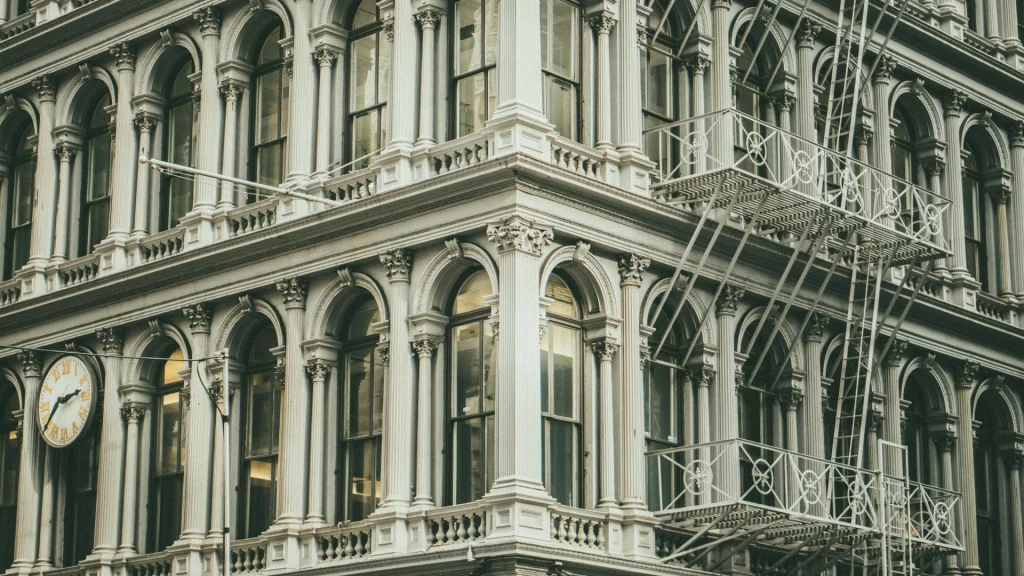
In New York City, construction costs are at new unprecedented levels, and they got there quick. We saw seemingly weekly increases during covid and since that have not stopped. It’s a perfect storm of antiquated labor laws, personal injury scams, and soaring insurance premiums are hammering the industry, and owners are left to pick up the tab. Even routine façade maintenance can be a stickershock event, with scaffolding and other soft costs running into the hundreds of thousands, if not millions, depending on the size of your building.
New York’s antiquated “Scaffold Law” known by industry insiders, and officially known as Labor Law § 240/241. There is a ton of information on google for and against this law. Enacted in 1885, it holds property owners and contractors absolutely liable for gravity-related injuries, regardless of any contributing negligence by the worker. This means falling from any height, or if something falls on to someone, whether the people involved are sober or not. While its original intent was to enhance worker safety, today it stands as a singular relic that is being exploited. New York is the only state that has such an uncompromising liability standard.
Insurance premiums for construction projects in New York can be multiples of those in neighboring states. According to CRC Group the Tappan Zee Bridge replacement, where some estimates believe the Scaffold Law tacked on an additional $400 million in costs.
Adding another layer are the fraudulent schemes exploiting the Scaffold Law which have proliferated, and have in turn caused both contractor and building insurance to skyrocket. These are elaborate schemes orchestrated by shady lawyers, doctors, and even MS-13 and Russian crime syndicates. Over the past four (4) years we have seen a huge spike in these claims. In 2023-24, we know of five (5) claims on projects of active projects. It later came out that all claimants were giving fake addresses located in the city including Upper East Side and East Village, which is not typically where the work force lives and pointed to something suspicious.
As reported by the NY Post workers are being used as pawns in staged construction accidents and having procedures they don’t need. These fraudulent claims not only contribute to the overall increase in premiums, they do not make workers safer, and add unnecessary bureaucracy when hiring and vetting contractors insurance policies.
In NYC, scaffolding isn’t just a nuisance it’s almost a running tax. Sidewalk bridges or scaffolding as most people refer, are the protective measures required by the city to keep the public safe either because the facade is in poor condition, and/or there is work taking place at the building that requires the sheds.
Property owners find themselves ensnared in a costly web. Contractors are transferring their insurance burdens downstream, owners are left footing exorbitant bills for even the most routine maintenance. This financial strain can be particularly acute for co-op and condos, which often operate on tight budgets. The unexpected surge in maintenance costs can lead to increased fees for residents, which is never popular within a building or deferred maintenance, potentially compromising building safety. Lately, we have seen several large commercial buildings defer facade maintenance, and opt to keep a shed in place without performing work. Recently, we were working next to a Fifth Ave building commercial, and one day the contractor disappeared, but not the bridge. One has to assume they ran out of money.
The city’s economy takes a hit as well. A study commissioned by NYC.gov and conducted in cooperation with Mastercard revealed that sidewalk sheds and scaffolding cost Manhattan businesses thousands of dollars each month in lost revenue. Restaurants and bars are hit hardest, experiencing a 3.5% to 9.7% decrease in weekly transactions in the six months following the installation of a shed.
The call for reform is increasingly growing louder. The industry argues that the Scaffold Law is outdated, thereby inflating construction costs and stymieing progress. They advocate for a comparative negligence standard, which would consider the actions of all parties involved, rather than imposing absolute liability on owners and contractors. Such a shift would reduce premiums and help the city build new buildings and maintain existing buildings.
The Scaffold Law stands as a costly anachronism of yesteryear when workers were more vulnerable. Its rigid liability standards combined with rampant fraud, enriching the doctors and lawyers, while causing the costs of doing business to go up precipitously, thereby making it almost cost prohibitive to do construction work. Routine maintenance jobs that used to be paid out of an operating budget, now require financing.