
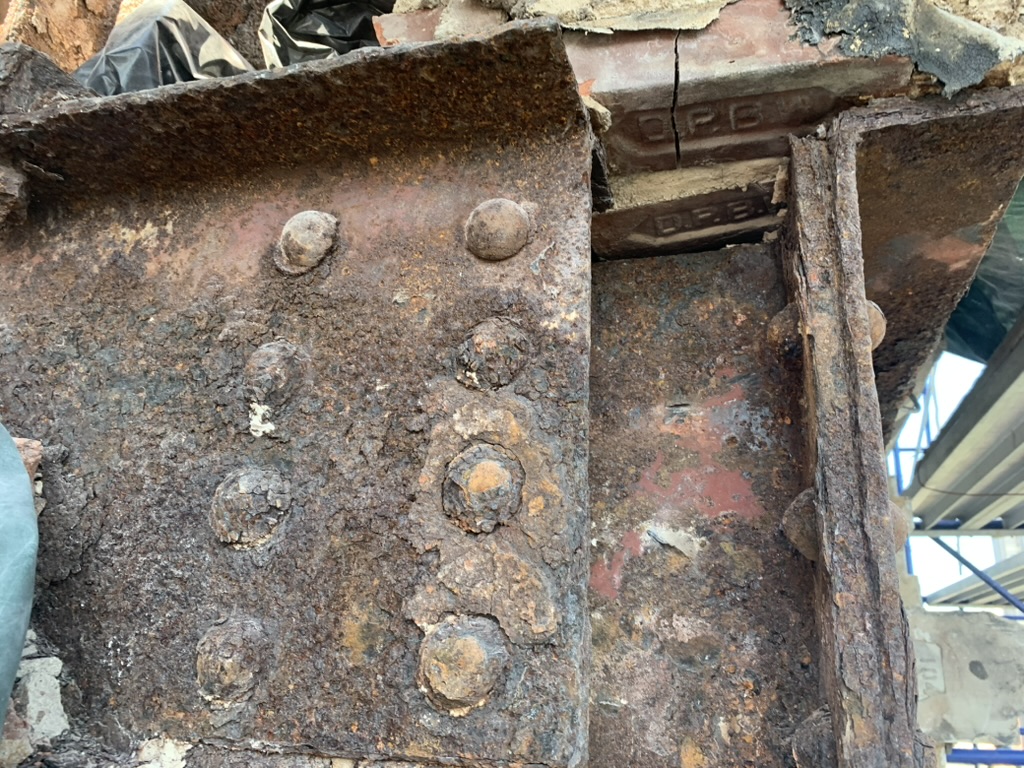
Steel makes New York possible. From the hidden angles inside a brownstone lintel to the reinforcing bars beneath concrete decks, it holds the city together and gives it shape. Yet steel’s great strength comes with one weakness: it rusts.
Once corrosion begins, it rarely stops on its own. And when owners treat rust as a cosmetic issue instead of a structural one, the damage quietly spreads until it costs ten times more to correct.
Why Most Repairs Miss the Mark
Budget pressure drives many repair decisions. It’s understandable given how pricey façade and structural work in New York tends to be. So owners naturally look for the smallest fix that satisfies the report. The corrosion meanwhile goes about its business.
By the time rust is visible, surrounding steel is already losing cross-section. As it expands, it cracks masonry or concrete, letting in more water and oxygen. The result is a feedback loop, a slow-motion failure that accelerates with every season.
Replacing a single lintel or cleaning one beam end may tidy the façade, but it rarely addresses the system. Without tackling the source conditions, the same problem reappears nearby within a few years. The front-end “savings” vanish after repeat mobilizations and new violations.
Understanding How Corrosion Spreads
It’s worth taking stock that not all rust looks the same, and the most dangerous kinds aren’t visible from the surface.
Pitting corrosion starts as pin-sized cavities, often caused by salts or sea air, and can eat deeply into steel.
Crevice corrosion hides under washers and sealant joints where moisture stagnates — common in curtain-wall anchors and window lintels.
Galvanic corrosion occurs when dissimilar metals touch, like steel against aluminum, causing one to corrode faster.
Stress-corrosion cracking develops under constant tension, producing hairline fractures that propagate over time.
Corrosion fatigue results from vibration or wind cycles acting on already compromised steel.
Each type has its own chemistry, but all share one trait: once started, they spread until the environment changes or the steel is replaced.
Seeing the Unseen: Modern Investigation Tools
Opening every wall isn’t practical, but guessing isn’t an option either. That’s where non-destructive testing (NDT) allows precision without demolition.
Engineers now rely on tools such as:
Ground-penetrating radar to locate embedded steel and voids.
Infrared thermography to reveal moisture behind finishes.
Half-cell potential testing to measure active corrosion in reinforced concrete.
Ultrasonic testing to gauge wall thickness and internal flaws.
Ferroscan mapping to chart rebar layout and corrosion potential.
Used together, these methods expose the true extent of deterioration so that repairs can be designed for cause, not appearance.
Why Comprehensive Repairs Pay Off
Corrosion doesn’t respect phase lines or budget cycles. When repairs address only what’s visible, unseen deterioration keeps advancing. Comprehensive restoration that involves cleaning, coating, waterproofing, and detailing improvements all costs more upfront. But critically it’s how to break the cycle of recurring damage.
Owners who plan full-system interventions gain not only project relief but also fewer emergency calls, lower long-term costs, and a façade that stays compliant through multiple FISP cycles.
The Real Lesson
Corrosion does not arrive by chance. It begins silent, invisible and punishes hesitation. Treating the damage with half-measures only ensures you’ll face the same problem again only with larger, deeper, and more expensive interventions.
The right time to fix steel isn’t when you see rust. It’s when you first understand why it formed.
Because in building restoration, doing a little less today almost always means doing everything over tomorrow.