
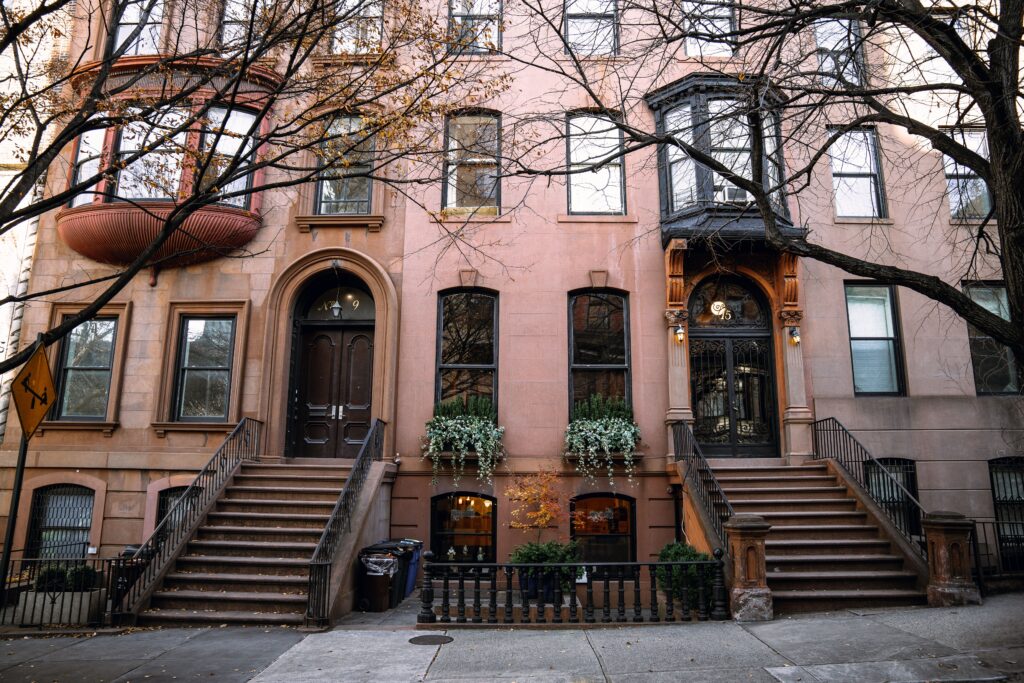
A building on West 71st Street, between Central Park West and Columbus Avenue, spent about a year trying to get approval to repoint 90 linear feet of mortar on its third and fourth floors. A notice posted on the building’s sidewalk shed said the board had submitted nine mortar samples to the Landmarks Preservation Commission and that all of them were refused. LPC says it gave feedback on the samples. According to LPC, it issued a Permit for Minor Work in November 2025 and approved the final material sample on June 10, 2026.
In the period the City Comptroller audited, which ended in June 2025, LPC took an average of four business days to issue a staff-level permit once an application was complete, according to the audit, published in December 2025.
Both figures are accurate. The gap between them is time LPC’s published averages don’t count, and since the new shed laws took effect in January, that time carries DOB penalties. The facade inspection rules and the new sidewalk shed laws each run on their own deadlines, and none of them stops for Landmarks review. If your building is an individual landmark or sits in a historic district, this article covers where LPC fits in a facade repair, what its published processing times leave out, and how to build its review into a schedule the City now enforces with penalties.
What applies to a landmarked building
Exterior work on an individual landmark, or on any building in a historic district, needs an LPC permit. That includes work that also needs a DOB permit, and work that DOB doesn’t require a permit for at all. DOB won’t approve a filing on a landmarked building until the LPC permit is uploaded to DOB NOW.
LPC issues three kinds of permit:
- A Certificate of No Effect — for work that needs a DOB permit but doesn’t affect the building’s protected features.
- A Permit for Minor Work — for work on protected features that doesn’t need a DOB permit, such as masonry cleaning or repair.
- A Certificate of Appropriateness — for work that doesn’t meet LPC’s rules for approval by staff. It goes to a public hearing before the full Commission, after a presentation to the local community board.
About 95% of LPC approvals are issued at staff level, without a hearing. Which permit a FISP repair ends up with depends on whether it needs a DOB permit and whether the work fits LPC’s rules.
Two other points matter for a facade repair. Some emergency measures don’t need an LPC permit, such as tarps over holes, boarding up openings or removing loose facade pieces, but the permanent repair does. An open LPC violation on the building can hold up DOB permits, except a permit to correct an unsafe condition.
What LPC’s processing times measure
The Comptroller’s audit measured LPC’s processing time from the date an application is complete to the date the permit is issued. Since LPC moved its applications onto its Portico portal in March 2024, the averages have been:
- Certificate of No Effect: 4 business days
- Permit for Minor Work: 4 business days
- Certificate of Appropriateness: 25 business days
Those averages are accurate for what they count. However, they leave out three stretches of time that can run much longer.
Time before the application counts as complete
The clock starts only when LPC staff deem the application complete. Until then, staff review the drawing set and send comments, often on specific details they object to. They are also particular about photographs: photos of existing conditions and sightline photos, which show how the work will look from the street, have to be in the set. Each round of comments goes back to the architect or engineer to revise and resubmit, and none of that time counts toward the averages.
Time waiting on an approved sample
For repointing, masonry repair and replacement masonry, LPC’s rules require at least two samples, and work “may not commence or proceed” until staff approve one. The approved sample becomes the standard for the whole job.
Samples must set or dry before they are photographed or inspected, and a rejected sample means a new round. LPC can issue a permit with the samples still to be approved, which is what happened on West 71st Street. The permit came in November 2025, and under the rules the repointing could not begin until a sample was approved in June.
Time added when work goes beyond staff approval
For a FISP repair, staff approval covers most of the work, within limits. At staff level, repairs to brick and glazed terra cotta are limited to minor spalling or chipping. Replacing a feature requires documentation that it can’t be repaired. Substitute materials, such as a cast replacement for carved stone, face limits that are strictest at individual landmarks. LPC has proposed rule changes that would let staff approve more of this work, including substitute terra cotta at individual landmarks. Work outside these rules goes to a hearing, and that usually means adding something the building doesn’t have, such as a new window opening or a new structure. Certificates of Appropriateness averaged 25 business days once complete, against 4 for staff-level permits.
Read this way, the West 71st Street case and the four-day average don’t conflict. An LPC spokesperson acknowledged in June that “in a small number of cases, the process has been overly long,” and said the agency is changing its processes to speed up reviews. It has since proposed the rule changes described above.
Why LPC is strict about mortar
Sample rounds are the stage most likely to repeat, so it helps to know what the samples are for.
Historic brick and brownstone are softer and more porous than modern masonry. The mortar between them was made softer still, usually from lime. Moisture that gets into the wall dries out through the joints, and when the wall expands and contracts with the temperature, the joints take the movement. When the mortar wears out, it is raked out and replaced, which costs far less than replacing brick or stone.
Mortar with a high proportion of Portland cement is harder and less permeable than most historic masonry. Used to repoint an old wall, it reverses that arrangement. Moisture has to leave through the brick or stone instead of the joint, and the movement goes into the masonry units. Water held near the face freezes and thaws, and salts crystallize as it dries, so the faces of the bricks or stones crack and spall while the new mortar stays intact.
LPC’s rules reflect this. Staff-level repointing requires mortar that matches the original in its physical and visual characteristics and is weaker and more permeable than the masonry around it. The samples are how staff confirm both.
For a board, the practical point is that sample rounds are part of the repair, and a schedule with no time for them will slip.
Three clocks that keep running
While the LPC application moves through these stages, three sets of City deadlines keep counting. None of them lists Landmarks review as a reason for delay.
FISP unsafe conditions — If your facade inspection report classified the building as Unsafe, the unsafe conditions must be corrected within 90 days of filing the report. Your engineer or architect can request an extension of up to 90 days, and the request must include a statement of all applicable permit requirements, along with the repair contract, a time estimate and the owner’s notarized affidavit.
A further extension is considered only on one of these grounds:
- An unforeseen delay to substantially completed work1
- Unforeseen circumstances, such as a fire
- A hazard that takes more than 90 days to remedy
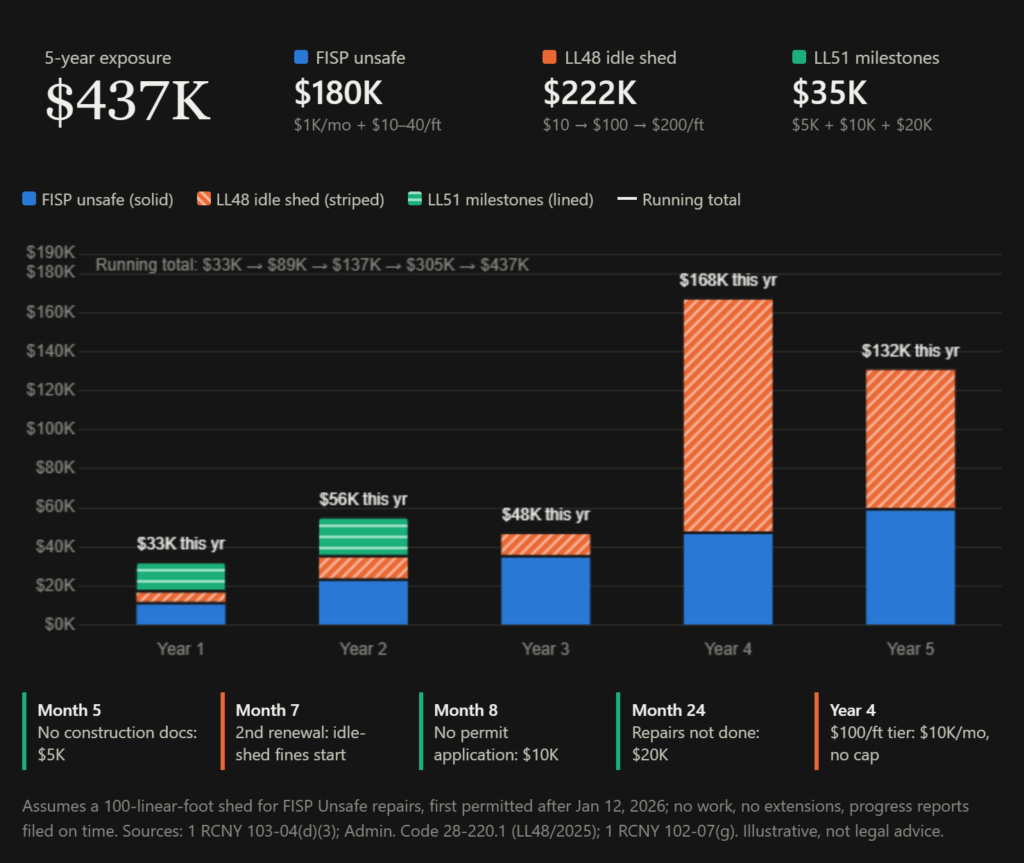
The request must include progress photos of the repairs. Financial reasons are never accepted. An unsafe condition left uncorrected carries a penalty of $1,000 a month. From the second year, DOB adds a monthly charge for every linear foot of shed, starting at $10 and rising to $40 by the fifth year. The penalty runs until DOB accepts an amended report showing the repairs done, the shed removed and the permits signed off, unless the Commissioner has granted an extension.
Local Law 48 — Every shed renewal now needs a progress report, and starting with the second renewal, work must be in progress during each 90-day permit period. The rule accepts three reasons for a period with no work: financial hardship, no access to a neighboring property and trouble getting materials. Your engineer or architect must give the reason in the report and confirm there is no hazard. Waiting for LPC approval is not one of the three. Penalties for an idle shed run from $10 to $200 per linear foot per month, depending on the shed’s age, capped at $6,000 a month once a shed is four years old, as our article on shed progress reports explains.
Local Law 51 — For a shed put up for FISP repairs whose first permit was issued on or after January 12, 2026, three milestones run from that permit: complete construction documents filed within five months, a complete permit application filed and pursued to issuance within eight months, and the repairs finished within two years. Missing them costs $5,000, $10,000 and $20,000.
Each milestone can be extended if your engineer or architect files a request between 60 and 20 days before the deadline, and every request must include a summary of all applicable permit requirements. A pending request pauses that milestone until DOB decides.
For a landmarked building, that summary is where the LPC application and its status go on record. It matters most at month eight, because DOB won’t approve the permit application until the LPC permit is uploaded.
Winter
LPC’s rules allow mortar and masonry work only when the temperature stays at 45 degrees Fahrenheit or above for 72 hours from the start of the work. Staff can approve heated enclosures or other controlled conditions case by case. In practice, full enclosures are rare: they are temporary structures that bring their own logistics with the City.
Samples are affected as well, because they have to set before LPC will review them. That is not a reason to hold them until spring. Contractors usually keep a winter sample on schedule with a heated blanket rather than an enclosure, so the approval is in hand when the weather allows the repair.
The repair itself is another matter. Boards and contractors generally expect masonry work to slow from December through March, but weather is not among the reasons Local Law 48 accepts for a period without work. If your schedule counted on masonry work this winter, the next progress report will have to explain why it stopped.
Frequently asked questions
Does a building in a historic district need LPC approval for FISP repairs?
Yes. Exterior work on any building in a historic district needs an LPC permit, as does work on an individual landmark. Temporary emergency measures are an exception, but the permanent repair still needs a permit.
Does LPC review pause the Local Law 48 or 51 deadlines?
No. Neither law lists agency review as a reason for delay. For the LL51 milestones, the route is an extension request, and it should document the LPC application. Filing an extension request pauses the milestone until DOB decides.
How long does LPC review take?
Once an application is complete, staff-level permits averaged four business days and Certificates of Appropriateness 25, according to the Comptroller’s 2025 audit. Preparing a complete application and getting samples approved take longer, and neither is included in those figures.
Can we repoint with a hard cement mortar if the color matches?
Not at staff level. LPC’s rules require repointing mortar that matches the original physically as well as visually, and that is weaker and more permeable than the masonry around it.
Before you file
Most delays described above can be planned for:
- Check the repair scope against LPC’s staff-level rules before the design is final. Fixing or replacing what the building already has can usually be approved by staff; adding something new goes to a hearing.
- Include photos of existing conditions and sightline photos in the first submission.
- Put sample rounds, and the time they need to set, into the schedule in your first shed progress report. That schedule is what later reports are measured against.
- Don’t hold samples for spring. If they go up in cold weather, plan for a heated blanket.
- Check the building for open LPC violations before the DOB filing.
- Make sure the LPC status is documented where DOB will look for it: in each progress report and in any extension request.
- DOB’s rule for the Facade Inspection & Safety Program, 1 RCNY §103-04(c)(5)(vi), gives weather and a labor strike as examples of this kind of delay. ↩