
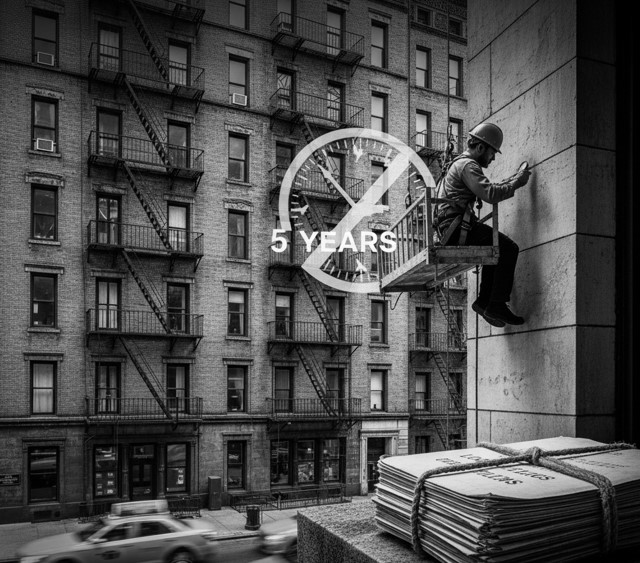
For more than 40 years, New York City has required periodic facade inspections for buildings taller than six stories. What began as necessary safety reform has become one of the most expensive and repetitive regulatory cycles in urban maintenance.
Under Local Law 11, owners must inspect and file reports every five years. No exceptions, no adjustments for performance history. But new conversation around Local Law 49 (Intro 394-A) suggest that rule might finally be up for reconsideration.
How the Five-Year Cycle Began
The inspection mandate was born from tragedy. In 1979, falling masonry on the Upper East Side claimed a life and triggered what became Local Law 10. That law evolved into Local Law 11 in 1998, which has now evolved again into FISP, expanding inspection scope and frequency to ensure no façade failure would go unnoticed.
For its time, the five-year requirement made sense. Building stock was older, construction materials less understood, and routine documentation minimal. The system created structure in an industry that had grown used to reactive maintenance.
But conditions have changed. The technology for assessment, reporting, and materials science has advanced. The same rule that once represented progress now risks crossing into redundancy.
Why the Current System Strains Owners and Inspectors
FISP compliance costs owners thousands of dollars every cycle, often before any actual repair work begins. Reports can exceed $20,000 for mid-size properties and escalate dramatically when scaffolding is required.
The law also generates a predictable but rigid workflow for engineers and QEWIs: thousands of filings compressed into overlapping windows. Many reports repeat the same findings cycle after cycle, with conditions marked “Safe with a repair and maintenance program” that have long since stabilized.
Meanwhile, the city’s façade division is inundated with paperwork. Valuable time is spent processing filings from buildings that pose little or no risk while others with real safety issues wait for enforcement or extension review.
What Local Law 49 Proposes
The proposed amendment doesn’t eliminate FISP, but opens a conversation for how long the well established duration of 5 year inspection windows should, if at all, be revised to, and what conditions would and should allow for longer inspection windows. Local Law 49 could authorize the Department of Buildings to develop a risk-based inspection schedule, among other potential ideas for lessening the inspection burden on buildings.
Well-documented, well-performing buildings could qualify for longer intervals — up to twelve years — while properties with prior violations, incomplete repairs, or known hazards would stay on a shorter cycle.
The DOB is currently conducting a study to evaluate how performance-based criteria could be structured. If adopted, it would be the most significant change to façade regulation in two decades.
The conclusion could be something simple: such as the inspection cycle windows increasing from every 5 years to every 6 years, or the study could conclude that the 5 year inspection window is the most optimal period for safety. Or they could go for something more thoughtful and complex, such as varying the window based on other building factors which have not yet been discussed.
The Argument for Change
No one in the industry disputes the importance of façade safety. The issue is efficiency. A uniform five-year rule treats every property the same regardless of condition or compliance history.
A well-maintained co-op with consistent “safe” filings shouldn’t carry the same burden as a neglected structure with repeat “unsafe” reports. Smarter scheduling would allow limited enforcement resources to focus where risk is greatest.
The cost savings could then flow toward proactive maintenance and work that actually prevents hazards instead of merely documenting their absence.
The Risks of Moving Too Fast
Extending inspection cycles isn’t without concern. A longer window may invite complacency, especially in buildings where ownership changes or maintenance budgets fluctuate. The five-year cadence has at least kept façades in public conversation; removing that regular reminder could weaken accountability. In addition, some conditions and defects in buildings could form over a short timeline, and become unsafe very quickly. Lengthening the inspection window increases the likelihood of these types of defects developing within buildings, thereby potentially increasing the hazard to the public.
The success of any reform will depend on how the city defines “low-risk.” Without clear standards, the rule could be exploited by owners seeking to delay routine work.
A Path Forward
Local Law 49 will make an attempt to make those who are not happy with the current inspection and reporting system happy, such as Owners and Property Management companies. There may be a case for technological changes allowing for a longer inspection window, if executed properly. A system built in the 80s could be modernized, if done with thoughtfulness to the real increased risks.
The city’s goal should be simple: maintain vigilance without waste. By introducing data-driven intervals that are more adaptable, New York could redirect resources where they matter most and finally strike a balance between safety, cost, and common sense.
It’s worth remembering that safety isn’t measured by how often you file. It’s measured by how well you maintain.
Lorem ipsum dolor sit amet, consectetur adipiscing elit. Ut elit tellus, luctus nec ullamcorper mattis, pulvinar dapibus leo.